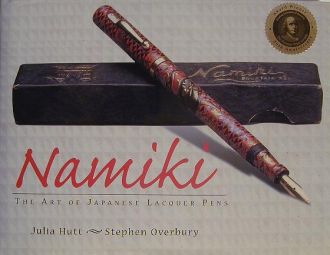
Namiki: The Art of Japanese
Lacquer Pens
by Julia Hutt and Stephen Overbury
|
|
This is a limited edition printing of 2000 numbered copies.
|
|
|
This book was recently awarded the outstanding "Award of Recognition" in the 50th annual Premier Print Awards - the printing industry's most prestigious awards competition. This important competition is organised by the Printing Industries of America, and for the year 2000, drew 5,393 entries from 14 countries. |
To order a copy, please visit www.vintagepens.net
| In 1926, the Namiki Pen Company of Japan attempted to increase its market share of writing instruments in Europe. To achieve this goal, the company took the innovative and bold approach of making use of the unique and ancient art of maki-e (sprinkled gold powders on lacquer paintings). Traditionally, maki-e had largely been applied on flat surfaces such as writing boxes or inro. Applying the painstaking art of maki-e on smaller circular objects was an ambitious undertaking. The companys secret success formula was a young but well known artist, Gonroku Matsuda, who was hired to select designs and train artists to produce high quality maki-e pens. Although only four hundred of these first quality writing instruments were made between 1926-1949, the craftmanship under Matsuda, the father of modern lacquer work in Japan, was recognised right from the start. By 1929 the internationally renowned Alfred Dunhill Ltd of London signed a distribution agreement with Namiki and began marketing Dunhill Namiki products which, today, continue to establish record-breaking prices among collectors around the world |
|
|
|
This book provides hundreds of brilliant colour images of the best writing instruments produced from the 1920s to the present, drawn from never-before-released archival material from the Pilot Pen Companys Museum, the Alfred Dunhill of London archives and from leading private collections around the world. It takes a look at the fascinating and widely varied motifs used in maki-e work. The authors also explore the techniques and tools used to produce this delightful art form. For the collector, there is an invaluable glossary with the Japanese signatures and English translations of the leading lacquer artists who worked for Namiki from the 1920s to the present.
|
The Authors
Julia Hutt graduated in Chinese Art and Archaeology from the School of Oriental and African Studies, London. She is Assistant Curator in the Far Eastern Department of the Victoria and Albert Museum (V&A) with responsibility for Japanese lacquer work and inro.
Stephen Overbury graduated from the University of Toronto and became an investigative journalist writing for several newspapers and magazines including The Globe and Mail and Barrons. He is the author of four books on business research techniques and the director of several companies. Twenty years ago, he developed a passion for pens and has become a leading dealer in fine and rare pens.
Book Specifications160 Pages
250 Colour Photographs
112 x 8.5" Landscape
Published October 2000
Limited edition publication of only 2,000 numbered pieces.